
The Clergy Corner
April 26, 2026
Today is the Fourth Sunday of Easter. We are now halfway through Eastertide. The nickname for this Sunday is Good Shepherd Sunday, because in all three years of the Lectionary Cycle, the Gospel is from Chapter 10 of the Gospel according to St John. In each of these sections of Chapter 10, Jesus talks about a shepherd and his sheep.
When I was the Dean of the Cathedral in Lima for nine years, this Sunday was a big day, because it was our Feast of Title, since the Cathedral is the Cathedral of the Good Shepherd. So we always made a big deal of it.
We can’t make such a big deal of it here, since it’s not our Feast of Title. (Actually, the Feast of Title for Grace Church is the Transfiguration, August 6. And no, this is Grace Church, not the Church of the Transfiguration, but there is no church feast with the name of “Grace.” And so centuries ago, church authorities decreed that the Feast of Title for and church named “Grace,” would be the Feast of the Transfiguration.)
But even though today is not our Feast of Title, we can still give it more than usual importance. Because our Lectionary is distributed over three years, it is uncommon that the same theme runs through all three years of any particular Sunday as clearly it does on this Sunday. And that theme is Jesus as the Good Shepherd of his sheep.
The particular emphasis on the theme for this year is actually a double emphasis. First, that sheep will follow their shepherd, because they know his voice, but they will not follow a stranger, because they don’t know his voice. Second, he is the door to the sheepfold.
Here Jesus is likening his followers to sheep. Just as sheep respond to their shepherd’s voice, we should respond to Jesus our shepherd, and not to a stranger. We are to follow Jesus, and not anyone sent by the devil.
And as the door to the sheepfold, he protects us. If we are part of his flock, he will not let any bad person or spirit harm us.
Fr. John +
May 10, 2026
Today is the Sixth Sunday of Easter, also known as Rogation Sunday. (Rogation is from the Latin rogare, which means “to ask.”) In earlier Prayer Books, this was actually the last Sunday after Easter because Ascension Day is this Thursday, and in previous Prayer Books it began Ascensiontide, which lasted 10 days until Pentecost. The editors of the 1979 Book of Common Prayer followed the Roman Catholic Church in lengthening Eastertide from 40 to 50 days, and making Ascensiontide a portion of Eastertide.
Today is also known as Rogation Sunday because the following three days are Rogationtide, days in which prayers were traditionally made that God would grant good weather so that the crops would prosper. During the three days between Rogation Sunday and Ascension Day, the clergy would “beat the bounds” of the parish, going in procession around the boundaries of the parish, praying as they went, and as they returned to the church building chanting the Great Litany.
In the USA we have greatly lost the idea that a parish has physical boundaries, the same as a city or a town, although in other countries that is still true. We still cling to the idea that a diocese has physical boundaries, although in the ACNA, that is not as strict as in other Anglican churches. Thus the Diocese of Pittsburgh technically includes the churches in southwestern Pennsylvania, but we also have churches in Tennessee, Illinois, and Minnesota, which are technically within the bounds of other dioceses.
Partly because we have become a more urban society, it is very uncommon for the clergy to beat the bounds of the parish during Rogationtide. However the custom of chanting the Great Litany in procession is still observed in many churches on Rogation Sunday, just as we are doing today. You are invited to join in the Procession and follow the clergy and altar party around the insides of the Nave, returning to your seats as you process up the centre aisle towards the end of the Litany.
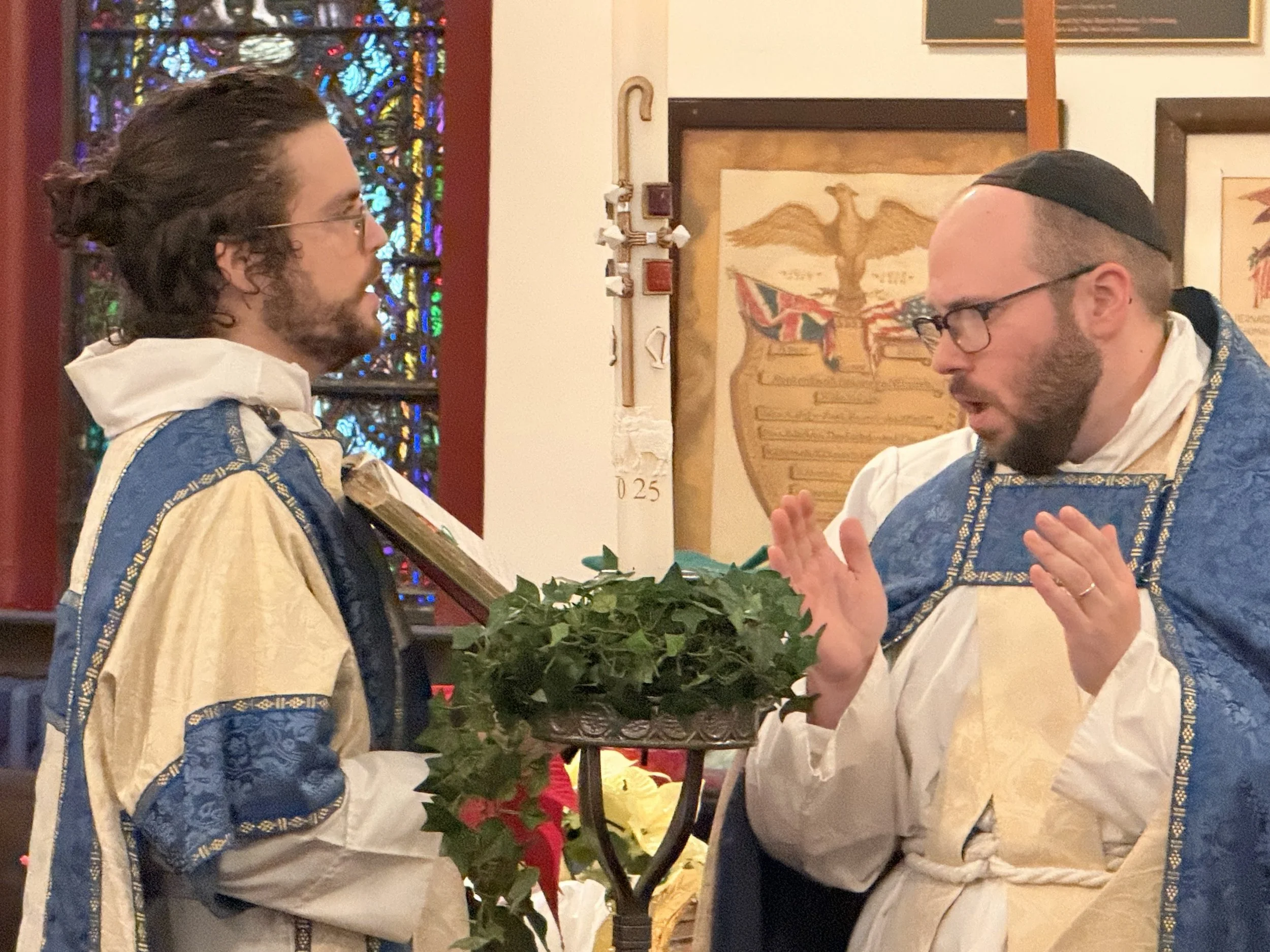
Fr Park is wearing a violet cope during the Procession, changing to a gold chasuble once he arrives in the Sanctuary, during the singing of the Trisagion, and wearing the gold chasuble during the Mass itself. This is because this morning we have two services in one: the Great Litany in Procession and the Holy Eucharist. Violet is the colour for the Litany, and gold is the colour for Eastertide.
Fr. John +
April 12, 2026
The Clergy Corner
The following is an excerpt from an Easter sermon preached by famous American Baptist pastor and theologian, Charles Spurgeon. May it bless you today as we think on the glory of the Risen Lord:
A gain, Christ wears these scars in his body in heaven as his ornaments. The wounds of Christ are his glories, they are his jewels and his precious things. To the eye of the believer Christ is never so glorious, never so passing fair, as when we can say of him, “My beloved is white and ruddy,” white with innocence, and ruddy with his own blood. He never seems so beautiful as when he can see him as the rose and the lily; as the lily, matchless purity, and as the rose, crimsoned with his own gore. We may talk of Christ in his beauty, in divers places raising the dead and stilling the tempest, but oh! there never was such a matchless Christ as he that did hang upon the cross. There I behold all his beauties, all his attributes developed, all his love drawn out, all his character expressed in letters so legible, that even my poor stammering heart call read those lines and speak them out again, as I see them written in crimson upon the bloody tree.
Beloved, these are to Jesus what they are to us; they are his ornaments, his royal jewels, his fair array. He does not care for the splendor and pomp of kings. The thorny crown is his diadem—a diadem such as no monarch ever wore. It is true that he bears not now the scepter of reed, but there is a glory in it that there never flashed from scepter of gold. It is true he is not now buffeted and spit upon: his face is not now marred more than that of any other man by grief and sorrow, for he is glorified and full of blessedness; but he never seems so lovely as when we see him buffeted of men for our sakes, enduring all manner of grief, bearing our iniquities, and carrying our sorrows. Jesus Christ finds such beauties in his wounds that he will not renounce them, he will wear the court dress in which he wooed our souls, and he will wear the royal purple of his atonement throughout eternity.
Nor are these only the ornaments of Christ: they are his trophies—the trophies of his love. Have you never seen a soldier with a gash across his forehead or in his cheek? Why every soldier will tell you the wound in battle is no disfigurement—it is his honor. “If” said he, “I received a wound when I was retreating, a wound in the back, that were to my disgrace, If I have received a wound in a victory, then it is an honorable thing to be wounded.” Now, Jesus Christ has scars of honor in his flesh and glory in his eyes. He has other trophies. He has divided the spoil with the strong: he has taken the captive away from his tyrant master; he has redeemed for himself a host that no man can number, who are all the trophies of his victories: but these scars, these are the memorials of the fight, and these the trophies, too.
March 1, 2026
The Clergy Corner
The following excerpt is a reflection on the Lenten discipline of fasting by St. Basil. May it bless you richly on your journey:
Do you fast? Then feed the hungry, give drink to the thirsty, visit the sick, do not forget the imprisoned, have pity on the tortured, comfort those who grieve and who weep, be merciful, humble, kind, calm, patient, sympathetic, forgiving, reverent, truthful and pious, so that God might accept your fasting and might plentifully grant you the fruits of repentance.
It is necessary most of all for one who is fasting to curb anger, to accustom himself to meekness and condescension, to have a contrite heart, to repulse impure thoughts and desires, to examine his conscience, to put his mind to the test and to verify what good has been done by us in this or any other week, and which deficiency we have corrected in ourself in the present week. This is true fasting.
As bodily food fattens the body, so fasting strengthens the soul; imparting it an easy flight, it makes it able to ascend on high, to contemplate lofty things and to put the heavenly higher than the pleasant and pleasurable things of life.
The point is not only that we should come to church each day, that we should continually listen to one and the same thing, and that we should fast for the whole Forty Days. No! If we, from continually coming here and listening to the teaching, do not acquire anything and do not derive any good for our soul from the time of the fast all this does not procure for us any benefit, but rather serves for our greater condemnation, when despite such concern for us by the Church we remain just the same as before.
Do not say to me that I fasted for so many days, that I did not eat this or that, that I did not drink wine, that I endured want; but show me if from an angry man you have become gentle - from a cruel man you have become benevolent. If you are filled with anger, why oppress your flesh? If hatred and avarice are within you, of what benefit is it you drink only water? Do not show forth a useless fast: for fasting alone does not ascend to heaven.
-St. Basil the Great, On Fasting
February 15th, 2026
“And whoever does not take his cross and follow me is not worthy of me. Whoever finds his life will lose it, and whoever loses his life for my sake will find it.”
(Matthew 10:38-39)
Blessings to you, dear friends on this last Sunday of the Epiphany season. This Sunday is traditionally called: Quinquagesima Sunday (Trying saying that five times fast!), and marking the approximate 50th day from the triumphant celebration of our Lord’s Resurrection on Easter! This Sunday not only marks the end of Epiphany, but the last Sunday in our pre-Lenten transition.
This Epiphany, rather than following the old Anglican tradition of beginning this pre-Lenten tide as we had last year, we set that practice aside in order to focus on the more festive occasions that coincided so often with our Sunday worship. Not to mention, it was a nice reprieve given the severity of the snow and having to close the church two Sundays in a row! All the same, as I have urged you these past few weeks, I do so now with the heightened awareness that the beginning of Holy Lent is imminent.
So why Transfiguration at all during this time of preparing for our somber journey towards Holy Week? The observation of Transfiguration at the end of Epiphany is quite a modern innovation. It seems strange, at a glance, when you consider that the proper feast day is still August 6th, occurring in the middle of summer. Upon closer examination, however, you might sense the welcomeness of this change. In the ordering of events in the Synoptic Gospel tradition (Matthew, Mark, and Luke), the Transfiguration is the last great act of our Lord prior to the disciples turning towards Jerusalem.
In other words, not only is it, in itself a feast of great Christological significance that fits thematically in Epiphanytide, but it also represents a pivot point in the story of Jesus’s earthly ministry. From this point on, he is laser focused on his mission that will ultimately carry him into the hands of the Pontius Pilate where he will be sentenced to death. The Transfiguration is, in that sequential context, a vision not just of God’s glory revealed in Jesus as he was before the Incarnation, but it is a vision of what will be. It is, from a certain point of view, kind of like a spoiler reveal of the end of the story before we even get to the tale’s climax!
This “spoiler” is meant to be taken as an encouragement. As we approach Golgotha spiritually and liturgically, as the stench of ash and death lingers in the air, we are reminded that the story does not end in the grave. In that spirit, how appropriate is it to celebrate Transfiguration on this day?! Anglicans, in spite of our strong rootedness have never been afraid of innovation when it calls us deeper into the story of scripture. True enough that this same tendency has gotten us into trouble from time to time. Not here! As we think about our Lenten journey that is to come, let us do so with the reminder of Christ’s glorious Resurrection already in our hearts and on our minds!
The Rev’d Tyler J. Gongola, Rector
February 8th, 2026
"Truly, I say to you, unless you turn and become like children, you will never enter the kingdom of heaven. Whoever humbles himself like this child is the greatest in the kingdom of heaven." (Matthew 18:3-4)
I started helping my mother with Sunday school when I was thirteen years old. I cut paper plates, refilled glue cups, and helped facilitate the games. In the summer, I served as a pre-school guide for VBS and soon graduated to leading music on a few occasions. Even in seminary, I found myself repeatedly serving the children of the Church and I have come to believe there is no greater honor, though there are certainly a great many challenges.
There is a common and unfortunate misconception that Children's Ministry is all about keeping the children busy with Bible stories so that the adults can do the real business of worship or study. But the reality is that, while little bodies may have different needs than older bodies, they are just as integral and important to the life of the church. While it rarely ever goes as planned, nor is it a particularly quiet or orderly job, it is one I am blessed to take part in. Even in the moments when they are too loud, or difficult, or just tired, they remind us of our own humanity and our need of a Savior.
Imagine the court room of a King, a grand open room with a throne at the front. There are those who are talking with the King directly, there are those off to the side having a conversation about other matters, and there are others running around playing some sort of game. They are all welcome in the King’s court because they have been invited.
As adults, we often complicate things to a point of being incomprehensible. We become haughty and self-absorbed, assuming that worship must sound, look, and smell a certain way; allowing our preferences to cloud the true purpose for our gathering. It has been in striving to teach children the beauty of the Christian faith that I have often found the most healing for my own soul; in stripping away the pride and being willing to meet children at the foot of the cross, to tell them the truth about our Lord and Savior Jesus Christ, who wants them to be part of his family because he loves them.
Retreating to the nursery each week, though strategic, is not for the benefit of the adults worshiping in the nave. Nor is the time spent there less worshipful than that spent in the nave. It’s a time to provide space for the type of learning that children crave: not simply playful, but relational. It is my desire that each child who comes through our catechesis program not only learns the truth of God’s love but experiences it through our love of them.
May we image the grace, mercy, and love of our Lord Jesus Christ for the children of Grace, and remember that, in their childhood, they too image Christ.
Megan Gongola, Lay Catechist to Children and Families